Most people shop for “tomatoes” the way you would shop for milk. One word, one bin, grab whatever is closest.
But a tomato is not one thing. A cherry tomato and a canning tomato are about as interchangeable as a paring knife and an axe. They are built differently, they hold different amounts of water, and using the wrong one is the single most common reason a homemade sauce comes out thin, a salad comes out soggy, or a batch of canned tomatoes ends up half water in the jar.
Once you know which tomato does which job, everything you make with them gets noticeably better. Here is the short course, and where to find each one.
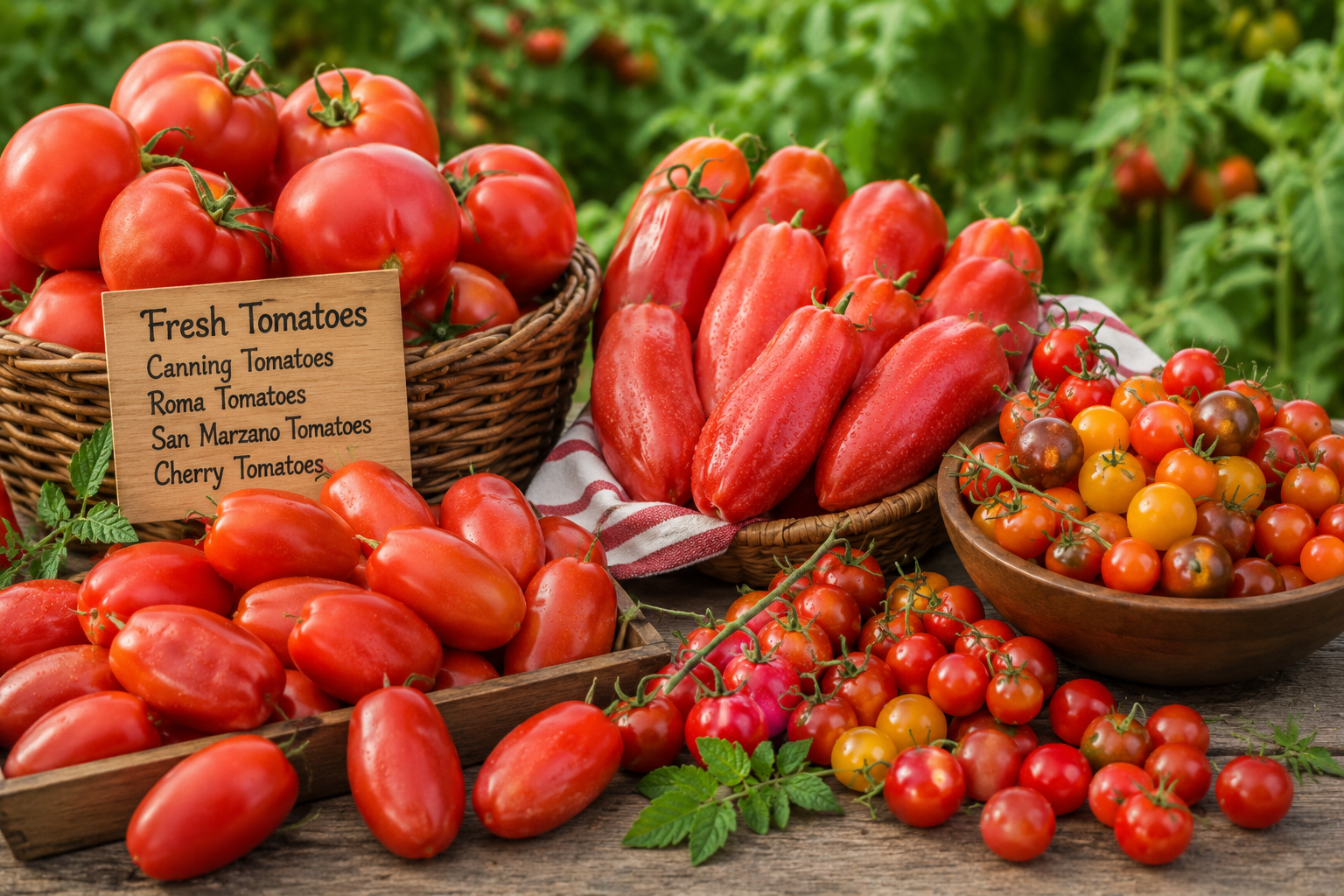
If you have been searching for fresh tomatoes in Kelowna, canning tomatoes in Kelowna, Roma or San Marzano tomatoes, or local Okanagan tomatoes, Don-O-Ray Farms has them at 3443 Benvoulin Road in Kelowna’s Lower Mission.
Fresh Field Tomatoes
This is the tomato people mean when they say they miss real tomatoes. Round, heavy, a little irregular, with thin skin and a smell at the stem that hits you before you have even cut it.
Field tomatoes are high in water and high in flavour, which makes them exactly right for eating fresh and exactly wrong for cooking down. Slice them thick for sandwiches and burgers. Layer them with basil and good olive oil. Chop them into salsa. Salt them and eat them over the sink like a peach.
The trade off is that they do not keep long once fully ripe, so buy what you will use in the next few days rather than stocking up.
Look for: deep even colour, taut unblemished skin, a fruit that feels heavy for its size, and a real tomato smell at the stem end. Firmness should give slightly under your thumb without denting.
Roma Tomatoes
The workhorse. Roma tomatoes are oval, dense and noticeably drier inside than a field tomato, with thick walls and only small seed pockets. That lower water content is the whole point: when you cook a Roma down, you are not standing at the stove for two hours boiling off liquid.
Romas are the right call for sauce, paste, salsa, soup, roasting, and anything that goes in the oven. They are also excellent halved, tossed in olive oil and salt, and roasted slowly until they collapse.
They are not the best tomato for a fresh salad. The flesh is firmer and the flavour is less bright than a field tomato, which is a feature when it is concentrated by heat and a drawback when it is raw.
San Marzano Tomatoes
If Roma is the workhorse, San Marzano is the specialist.
San Marzano is a variety, long and tapered, with dense flesh, very few seeds, thin skin that slips off easily after a blanch, and a lower acidity with a distinctly sweet finish. It is the tomato Italian cooks reach for when the sauce has nowhere to hide, which is why it is the traditional choice for a simple marinara or a Neapolitan pizza sauce where there are only three or four ingredients in the pot.
A note worth knowing: the protected San Marzano designation refers to fruit grown in a specific volcanic region of Italy. The variety itself is grown well beyond that, and a fresh, locally grown San Marzano gives you something the imported tinned version cannot, which is a tomato that has not spent months in a can. If you are making sauce from scratch, it is the best starting point on the shelf.
Cherry Tomatoes
Small, sweet, high sugar, and built to be eaten by the handful. Cherry tomatoes concentrate their sugars in a much smaller volume, which is why they taste sweeter than a big slicing tomato even when both are perfectly ripe.
They are the easiest tomato to use. Toss them whole into salads, thread them onto skewers, blister them in a hot pan with garlic until they burst and turn themselves into a sauce, or roast them alongside chicken. They also travel and keep better than a full sized tomato, which makes them the practical choice for lunches and picnics.
Look for: glossy, taut skin with no wrinkling or splitting, and fruit still on the vine where possible. A split cherry tomato means it took on water quickly and will not keep.
Canning Tomatoes
Canning season is the reason a lot of people show up at a farm market in the first place.
Canning tomatoes are sold in volume for a reason. You need far more fruit than most people expect, and buying by the box is both cheaper and less work than picking through loose tomatoes ten at a time. Roma and San Marzano are the two varieties best suited to it, because thick walls and low water are what stop your jars from separating into a layer of solids and a layer of pink water.
Rough planning numbers: figure on about 3 pounds of tomatoes per quart jar. A canner load of 7 quarts takes roughly 20 to 22 pounds. A standard bushel runs about 53 pounds and will give you somewhere in the range of 15 to 20 quarts depending on the variety and how much you cook the sauce down.
One safety note that matters: tomatoes sit right on the edge of the acidity level needed for safe water bath canning, and modern varieties vary. Every current tested recipe calls for adding acid to each jar, usually bottled lemon juice or citric acid, regardless of how the tomatoes taste. Bottled lemon juice specifically, because fresh lemons vary in acidity. Follow a current tested recipe from Bernardin or a provincial extension guide rather than an old family method, and you will be fine.
Timing wise, tomatoes for canning generally peak from late August into September in the Okanagan. It is worth calling ahead before you plan a full canning weekend around it.
How to Store Tomatoes at Home
Do not refrigerate them. This is the one rule that changes everything.
Cold permanently damages the compounds that make a tomato taste like a tomato, and it turns the flesh mealy. A tomato that has been in the fridge does not recover, even after it warms back up. Keep them on the counter, stem side down, out of direct sun, in a single layer rather than stacked in a bowl where the weight bruises the bottom ones.
If a tomato is slightly underripe, the counter will finish the job in a couple of days. If you have more fully ripe tomatoes than you can use, cook them down into a sauce and freeze that instead of chilling the whole fruit. Cut tomatoes are the one exception and should be covered and refrigerated.
Where to Buy Fresh and Canning Tomatoes in Kelowna
For anyone searching where to buy canning tomatoes in Kelowna, or simply looking for local Okanagan tomatoes worth cooking with, our farm market on Benvoulin Road in the Lower Mission is a straightforward stop. We restock fresh produce through the day, so what you take home has not been sitting.
Tomatoes also anchor most of what else is good in late summer. Pair them with fresh peppers, cucumbers, herbs, sweet corn or fresh strawberries earlier in the season and most of your summer cooking is already handled. You will find them alongside our full range of fruit and vegetables, Nature’s Kitchen products, and a family friendly farm stop that is worth the trip on its own.
Tomato FAQ
What is the best tomato for making sauce? Roma or San Marzano. Both have thick walls, dense flesh and low water content, which means less time boiling liquid off and a thicker sauce at the end. San Marzano is sweeter and lower in acidity, Roma is the reliable everyday choice.
How many pounds of tomatoes do I need for canning? About 3 pounds per quart jar. A 7 quart canner load takes roughly 20 to 22 pounds, and a bushel of around 53 pounds yields somewhere between 15 and 20 quarts.
When is tomato season in the Okanagan? Field tomatoes generally start showing up in mid summer, with the heaviest volume and the best canning tomatoes arriving from late August into September. Exact timing shifts with the weather each year.
Do I need to add lemon juice when canning tomatoes? Yes. Current tested recipes call for adding bottled lemon juice or citric acid to every jar, because tomatoes sit borderline on the acidity needed for safe water bath canning. Use bottled rather than fresh, since fresh lemons vary too much, and follow a current tested recipe.
Should tomatoes be stored in the fridge? No. Refrigeration permanently dulls the flavour and turns the texture mealy, and the damage does not reverse. Keep whole tomatoes on the counter, stem side down and out of direct sun. Refrigerate only after cutting.
What is the difference between Roma and San Marzano tomatoes? Both are paste tomatoes, but San Marzano is longer and more tapered, with fewer seeds, thinner skin and a sweeter, less acidic flavour. Roma is more widely available and more forgiving. San Marzano is worth seeking out for simple sauces where the tomato is the main flavour.
Where can I buy tomatoes in Kelowna? Don-O-Ray Farms stocks fresh tomatoes, Roma, San Marzano and cherry tomatoes at 3443 Benvoulin Road in Kelowna’s Lower Mission, with canning tomatoes available in volume through the canning season.
Come Pick Some Up
Whether you need two good tomatoes for tonight’s sandwiches or a box to get you through a canning weekend, they are on the shelf at the farm market on Benvoulin Road. Stop by and grab what you need while the season is on.